Arcata and Mad River Smoker 1
Item


Dublin Core
Title
Arcata and Mad River Smoker 1
Subject
Arcata and Mad River Smoker 1
Format
Railcar
Railcar Item Type Metadata
Location
SPCRR Carbarn
Objectives
Complete Restoration to ??? era
Physical Dimensions
25' Length
Builder / Manufacturer
Carter Brothers
Build Date
1885
Ownership / Custodial History
Built as Arcata & Mad River RR coach #2
1885
Converted to Smoking Car #1
(Date Unkown)
Placed on standard gauge flatcar #1 by Northern Redwood Lumber Company (Pressed Steel Car Co. Flatcar)
19XX
Moved to wooden flat car and repainted to NRLCo #3
19XX
Moved to McKinleyville
195X
Moved to temporary SPCRR Storage
11/2006
Moved to Ardenwood
20xx
1885
Converted to Smoking Car #1
(Date Unkown)
Placed on standard gauge flatcar #1 by Northern Redwood Lumber Company (Pressed Steel Car Co. Flatcar)
19XX
Moved to wooden flat car and repainted to NRLCo #3
19XX
Moved to McKinleyville
195X
Moved to temporary SPCRR Storage
11/2006
Moved to Ardenwood
20xx
Road Number
Arcata & Mad River Railroad 1
Historical Road Numbers
AMRR No. 2
(1885)
AMRR No. 1
(????)
NRLCO #1
(19XX)
NRLCo #3
(19xx)
HNRR No X
(195X)
(1885)
AMRR No. 1
(????)
NRLCO #1
(19XX)
NRLCo #3
(19xx)
HNRR No X
(195X)
Car Type
Coach/Caboose
Dimensions
25'
Restoration History
2025: Restoration report started
Date Acquired
2006
Restoration / Conservation Notes
Under Restoration
Status
Semi-operable
Online Description
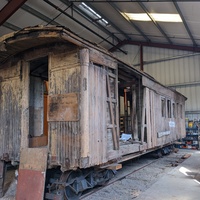
This 25-foot passenger coach was constructed by Carter Brothers of Newark in 1885 for the Arcata & Mad River Railroad as their coach #2, serving California's North Coast lumber country on rare 45.25-inch gauge track, - a legacy of the AMRR being the first railroad ever established in California. The car featured wood body and underframe construction, 4-wheel arch bar trucks with 24" cast wheels and 3-1/2"x5" journals, oil lamps, stove heating, and open platforms.
The car's service history reflects the adaptive reuse common to narrow gauge equipment. It was converted to Smoking Car #1 and appears in the 1916 A&MR roster with a noted purchase price of $1,250 (listed as "purchased second hand"). It is listed as:
Smoker
No. 1; wood body and underframe; length over end sills 25’– 0”; 4 wheel arch bar trucks with 24” cast wheel; 3-1/2”x5” journals; oil lamps; stove; open platforms; purchased second hand. New cost $1,250.
Following the A&MR's conversion to standard gauge, the car was rebuilt with the addition of a cupola for dual passenger-caboose service.
The carbody had an extensive secondary life with industrial railways. It passed to the Northern Redwood Lumber Company where it was renumbered as #1 and the body was first placed on a standard gauge Pressed Steel Car Company flatcar #1, then later transferred to a wooden NRLCo flatcar and repainted as NRLCo #3. In the 1950s, the car was acquired by a private railroad operator in McKinleyville, California, where its frame was reinforced and mounted on trucks from the former Prather Lumber Company. Contemporary sources claimed these were ex-Northwestern Pacific trucks, though this has not been verified; the same truck style was used by the Nevada County Narrow Gauge Railroad.
Northern California narrow gauge collector Henry Sorenson donated the car to SPCRR in 2006. It was initially stored in temporary indoor facilities beginning November 2006, then later moved to Ardenwood Historic Farm. A significant archaeological discovery in 2025 revealed an original Carter Brothers builder's stencil on an interior door, providing definitive proof of the car's construction provenance. A comprehensive restoration report was initiated in 2025. The car currently awaits full restoration and is not operational.
The car's service history reflects the adaptive reuse common to narrow gauge equipment. It was converted to Smoking Car #1 and appears in the 1916 A&MR roster with a noted purchase price of $1,250 (listed as "purchased second hand"). It is listed as:
Smoker
No. 1; wood body and underframe; length over end sills 25’– 0”; 4 wheel arch bar trucks with 24” cast wheel; 3-1/2”x5” journals; oil lamps; stove; open platforms; purchased second hand. New cost $1,250.
Following the A&MR's conversion to standard gauge, the car was rebuilt with the addition of a cupola for dual passenger-caboose service.
The carbody had an extensive secondary life with industrial railways. It passed to the Northern Redwood Lumber Company where it was renumbered as #1 and the body was first placed on a standard gauge Pressed Steel Car Company flatcar #1, then later transferred to a wooden NRLCo flatcar and repainted as NRLCo #3. In the 1950s, the car was acquired by a private railroad operator in McKinleyville, California, where its frame was reinforced and mounted on trucks from the former Prather Lumber Company. Contemporary sources claimed these were ex-Northwestern Pacific trucks, though this has not been verified; the same truck style was used by the Nevada County Narrow Gauge Railroad.
Northern California narrow gauge collector Henry Sorenson donated the car to SPCRR in 2006. It was initially stored in temporary indoor facilities beginning November 2006, then later moved to Ardenwood Historic Farm. A significant archaeological discovery in 2025 revealed an original Carter Brothers builder's stencil on an interior door, providing definitive proof of the car's construction provenance. A comprehensive restoration report was initiated in 2025. The car currently awaits full restoration and is not operational.
Class
Collection
Carter Brothers?
Yes
Collection
Citation
Carter Brothers, “Arcata and Mad River Smoker 1,” The Railroad Museum at Ardenwood, accessed October 1, 2026, http://museum.spcrr.org/items/show/28.