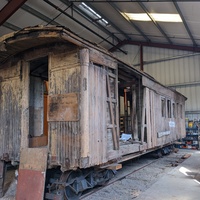
Nevada Central 253
Item
Dublin Core
Title
Nevada Central 253
Subject
Nevada Central 253
Format
Railcar
Railcar Item Type Metadata
Location
SPCRR Carbarn
Physical Dimensions
24' Length
Builder / Manufacturer
Thomas Carter
Build Date
September 1874
Ownership / Custodial History
Monterey and Salinas Valley RR
1874
Southern Pacific
August 1879
Nevada Central
October 1879
Robert Caudill
19XX*
Gold Strike Casino
196X
SPCRR
1992
1874
Southern Pacific
August 1879
Nevada Central
October 1879
Robert Caudill
19XX*
Gold Strike Casino
196X
SPCRR
1992
Road Number
Nevada Central 253
Historical Road Numbers
MSVRR #?*
(1874)
NC RR #253
(March 15, 1880)
(1874)
NC RR #253
(March 15, 1880)
Car Type
Box Car
Weight
8 ton
Dimensions
24'
Restoration History
On substitute trucks awaiting restoration.
Date Acquired
Feburary 28, 1992
Restoration / Conservation Notes
Cost $575.00 to build. Stolen by Robert Caudill (AKA 'dobe Doc'), Elko, NV circa 1940s. Part of collection "acquired" through dubious means. Sold to Gold Strike casino 196*X*-1964. Renamed Fort Lucinda 1964-1966. Gold Strike Inn Casino 1966-1991. Advertised in Wall Street Journal 19*X*. Memorandum of understanding November 15, 1991 between SPCRR and Gold Strike for trade. Donation/trade effective February 28, 1992. Moved to Ardenwood 1992.
Status
In Storage
Online Description
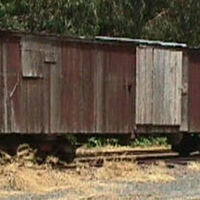
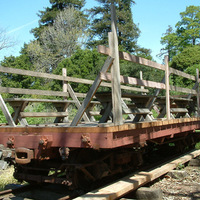
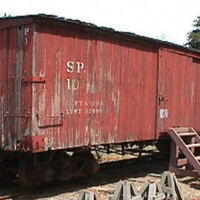
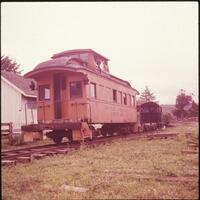
This 24-foot, 8-ton, 36-inch gauge boxcar represents the earliest surviving work of what would become Carter Brothers, before they were even the "Carter Brothers." Constructed in late September 1874 in the Monterey & Salinas Valley Railroad's car shop in Monterey, California at a cost of $575.00, it was one of eight boxcars in the M&SV's initial fleet (numbered 2 through 16, even numbers only). Metal castings were likely sourced from foundries in Santa Cruz or San Francisco. This was the first rolling stock construction job for Thomas Carter, who would soon establish the Carter Brothers firm with his brother Martin.
Modern legend has claimed these cars were "built on the beach in Monterey," but by late September 1874, the M&SV had a proper car shop structure built in early June 1874 on solid land near the beach, close to the M&SV depot and wharf. Newspaper accounts from the period confirm flatcar construction began there in late June 1874, followed by the boxcar order.
The M&SV was acquired by Pacific Improvement Company (Southern Pacific) at foreclosure in August 1879, with SP taking direct ownership on December 22, 1879. SP replaced the M&SV with standard gauge on a different route in 1880. All M&SV rolling stock and rail was sold to Nevada Central Railroad on October 19, 1879. The car arrived on the Nevada Central by March 15, 1880 as #253.
During Nevada Central service, the car underwent several transformations. NCRR boxcars were initially painted straw yellow/buff as of 1881 per newspaper accounts. The car was rebuilt at the NC's Battle Mountain shop in 1896 [details unknown]. Boxcars were repainted boxcar red around 1897. Between 1900 and 1908, automatic air brakes and 3/4-size Janney patent automatic (knuckle) couplers were installed. Another rebuild occurred at Battle Mountain in 1922-1923 [details unknown].
The car remained in service until February 2, 1938 when the Nevada Central was abandoned. Remarkably, it continued working on the railroad's own scrapping trains until September 27, 1938. For this final service, a large buffer timber was added to the "A" end to protect against loose rails on an adjoining flatcar, and a stove was apparently installed for crew use. The carbody was left at Battle Mountain, Nevada from 1938 to the 1940s.
The car's post-railroad history is colorful and controversial. It was stolen by a collector known as "'dobe Doc" and stored near Elko, Nevada. This individual had assembled a large collection of antiques, vehicles, and railroad equipment "acquired" through dubious means, continuously relocating items until 1992. An attempt to display the car in a proposed "old west" attraction near Elko was denied in 1947.
From 1950 to 1960, the carbody was displayed at the Last Frontier Hotel & Casino's "old west town" on the Las Vegas Strip. In 1960, it was moved to private storage near McCarran Airport in Las Vegas. Plans to move it to the proposed Apacheland tourist attraction in Apache Junction, Arizona in 1962 never materialized.
The car began its casino billboard career when sold to Gold Strike in the 196*s-1964, followed by rebranding as Fort Lucinda (1964-1966), then return to Gold Strike Inn Casino branding in 1966. By 1968, it was lettered "Saloon and Casino" in black on the yellow carbody. The car was advertised for sale in the Wall Street Journal in 19*X*. Billboard lettering changed after 1977, and by December 1990, it advertised "$50,000 Keno and Roulette, craps and '21'." It still has this advertisement today.
Preservation came through creative negotiation: On November 15, 1991. SPCRR and Gold Strike Casino executed a memorandum of understanding to trade NC 253's original carbody for a SPCRR-built replica ""fake"" boxcar to continue billboard service. The donation/trade became effective February 28, 1992. The car was moved to Ardenwood in 1992 and currently rests in storage on substitute trucks awaiting restoration. At 150 years old, it represents the oldest surviving Carter Brother-built freight car and documents both the pioneering era of California narrow gauge construction and the complex preservation pathways historic equipment often follows.
* Unknown date information, closest confident date range used.
[] Needs further research or citation
Modern legend has claimed these cars were "built on the beach in Monterey," but by late September 1874, the M&SV had a proper car shop structure built in early June 1874 on solid land near the beach, close to the M&SV depot and wharf. Newspaper accounts from the period confirm flatcar construction began there in late June 1874, followed by the boxcar order.
The M&SV was acquired by Pacific Improvement Company (Southern Pacific) at foreclosure in August 1879, with SP taking direct ownership on December 22, 1879. SP replaced the M&SV with standard gauge on a different route in 1880. All M&SV rolling stock and rail was sold to Nevada Central Railroad on October 19, 1879. The car arrived on the Nevada Central by March 15, 1880 as #253.
During Nevada Central service, the car underwent several transformations. NCRR boxcars were initially painted straw yellow/buff as of 1881 per newspaper accounts. The car was rebuilt at the NC's Battle Mountain shop in 1896 [details unknown]. Boxcars were repainted boxcar red around 1897. Between 1900 and 1908, automatic air brakes and 3/4-size Janney patent automatic (knuckle) couplers were installed. Another rebuild occurred at Battle Mountain in 1922-1923 [details unknown].
The car remained in service until February 2, 1938 when the Nevada Central was abandoned. Remarkably, it continued working on the railroad's own scrapping trains until September 27, 1938. For this final service, a large buffer timber was added to the "A" end to protect against loose rails on an adjoining flatcar, and a stove was apparently installed for crew use. The carbody was left at Battle Mountain, Nevada from 1938 to the 1940s.
The car's post-railroad history is colorful and controversial. It was stolen by a collector known as "'dobe Doc" and stored near Elko, Nevada. This individual had assembled a large collection of antiques, vehicles, and railroad equipment "acquired" through dubious means, continuously relocating items until 1992. An attempt to display the car in a proposed "old west" attraction near Elko was denied in 1947.
From 1950 to 1960, the carbody was displayed at the Last Frontier Hotel & Casino's "old west town" on the Las Vegas Strip. In 1960, it was moved to private storage near McCarran Airport in Las Vegas. Plans to move it to the proposed Apacheland tourist attraction in Apache Junction, Arizona in 1962 never materialized.
The car began its casino billboard career when sold to Gold Strike in the 196*s-1964, followed by rebranding as Fort Lucinda (1964-1966), then return to Gold Strike Inn Casino branding in 1966. By 1968, it was lettered "Saloon and Casino" in black on the yellow carbody. The car was advertised for sale in the Wall Street Journal in 19*X*. Billboard lettering changed after 1977, and by December 1990, it advertised "$50,000 Keno and Roulette, craps and '21'." It still has this advertisement today.
Preservation came through creative negotiation: On November 15, 1991. SPCRR and Gold Strike Casino executed a memorandum of understanding to trade NC 253's original carbody for a SPCRR-built replica ""fake"" boxcar to continue billboard service. The donation/trade became effective February 28, 1992. The car was moved to Ardenwood in 1992 and currently rests in storage on substitute trucks awaiting restoration. At 150 years old, it represents the oldest surviving Carter Brother-built freight car and documents both the pioneering era of California narrow gauge construction and the complex preservation pathways historic equipment often follows.
* Unknown date information, closest confident date range used.
[] Needs further research or citation
Class
Collection
Carter Brothers?
Yes
Collection
Citation
Thomas Carter
, “Nevada Central 253,” The Railroad Museum at Ardenwood, accessed October 1, 2026, http://museum.spcrr.org/items/show/36.