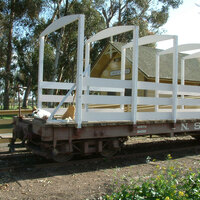
Diamond and Caldor 64
Item

Dublin Core
Title
Diamond and Caldor 64
Subject
Diamond and Caldor 64
Format
Railcar
Railcar Item Type Metadata
Location
SPCRR Yard
Objectives
Restore to 1907 condition
Physical Dimensions
24' length
Builder / Manufacturer
W.L. Holman & Co.
Build Date
07/15/1907
Ownership / Custodial History
Diamon & Caldor Railway
1907
Occupied by California Door Co.
1953
Property and car sold to XXXX as car no longer occupied.
19XX
Donated to SPCRR
1979
1907
Occupied by California Door Co.
1953
Property and car sold to XXXX as car no longer occupied.
19XX
Donated to SPCRR
1979
Road Number
Diamond & Caldor Railway 64
Historical Road Numbers
D&C 64
(July 15, 1907)
SPC 439 - Fictional
(198X)
D&C 64
(2001)
(July 15, 1907)
SPC 439 - Fictional
(198X)
D&C 64
(2001)
Car Type
Flat car
Weight
15 ton
Dimensions
24'
Materials/Construction
Wood, steel frame
Restoration History
Placed on SPCRR rails May 5, 1984 at Deer Park, where dismantling, documentation and restoration started. Restored by SPCRR and lettered as SPC # 439 (1985). Displayed Intact near SPCRR carbarn with an antique farm plow load; awaiting a complete rebuilding to return to service (2022)
Date Acquired
12/24/1979
Restoration / Conservation Notes
Lettered to imaginary SPC 439 for Ardenwood's opening day. Restored to D&C 64 in 2001. Retired from passenger service in 2016/2017
Status
Semi-operable
Online Description
This 24-foot, 15-ton, 36-inch gauge flatcar was built in San Francisco by W.L. Holman & Company on July 15, 1907 as Diamond & Caldor Railway lumber flatcar #64. It was part of a six-car order numbered either #61-66 or #64-69 (records conflict). As originally built, these cars were 36 feet long with 15-ton capacity, equipped with swinging arch bar (swing motion) trucks, 24-inch cast iron wheels, Westinghouse air brakes, and link & pin couplers. Construction was Oregon pine timber.
The cars were delivered without decking, which D&C added at a cost of $12.00 per car. Unloading from shipment cost $5.00. Total delivered cost was $697.60 per car ($651.00 plus $46.60 freight). At this time, the lumber mill was located in Caldor, and the D&C flatcars hauled rough-cut lumber 33 miles to the planing mill or the Southern Pacific interchange at Diamond Springs.
These cars were significantly longer than all other D&C flatcars (which were 20' and 24'). Mill crews habitually overloaded these longer cars, causing handling problems. Between 1908 and early 1913, the D&C shops cut all six cars down to 24 feet to match a prior 1905 order of 24' flatcars from Holman (#51-60). This substantial modification reflects the practical lessons learned in mountain railroading operations.
In June 1913, the California Railroad Commission valued these cars at $435.00 each with a replacement value of $550.00. The D&C's operations evolved significantly: In 1917, it began hauling logs from online points to the mill in Caldor using over sixty new 36-foot, 30-ton capacity, 4-bunk skeleton log cars built by Seattle Car & Foundry. The lumber mill in Caldor burned on July 13, 1923, and a new mill was built at Diamond Springs, opening in 1924.
From this point, the D&C mainly hauled logs from Caldor to Diamond Springs. The lumber-hauling flatcars were largely replaced by log cars, including another order in 1925 built by Pacific Car & Foundry. Car #64 may have been used as a work car or to haul lumber around the mill and drying yard. A bunk car body was built on top of the flatcar in 19*X* for employee housing. The D&C temporarily ceased operations between late 1929 and winter 1935 due to the Depression.
The railroad's end came through regulatory enforcement: The D&C had continued using link and pin couplers until 1953, though these had been outlawed on common carrier railroads in 1903. A California Safety inspector's discovery of this violation in 1952 required the D&C to upgrade to knuckle-style couplers. Rather than make this investment, the California Door Company (which owned the D&C) replaced rail operations with logging trucks. The final run occurred on June 20, 1953. Car #64 was left near Somerset, California as it was occupied by California Door Company logging employees.
The property and car were sold to a private party [date unknown] after the employees vacated. The car was donated to SPCRR by two families in 1979 (receipt of gift: December 24, 1979). SPCRR moved the car in July 1983, arriving at Ardenwood on July 4, 1983. It was stored near the barn until May 5, 1984, when it was placed on SPCRR rails at Deer Park and dismantling, documentation, and restoration began.
Historical misidentification occurred: When first recovered by museum volunteers, the car was believed to have been a former South Pacific Coast flatcar built by Carter Brothers that had been sold to the D&C. It was restored and lettered as SPC #439, becoming SPCRR's first passenger-carrying car. It operated on Ardenwood Historic Farm's opening day, Saturday July 27, 1985, under this guise. Later research proved this attribution incorrect, and the car was correctly relettered to D&C #64 in late 2001. The incorrect "SPC/Carter Brothers" attribution has been published multiple times and persists in some sources.
Original preservation plans: SPCRR initially intended only to recover the wheels, trucks, and metal parts from D&C #64 for use in restoring SPC #47 caboose for static display. Recovery of the entire car was not thought possible due to incomplete physical condition and the remote Somerset location. The car was retired from passenger service in 2016 or 2017 [verify exact date] and is currently displayed intact near the SPCRR car barn with an antique farm plow load, awaiting complete rebuilding to return to service.
Historical note: The D&C was owned by California Door Company, which shipped lumber from Diamond Springs to its door factory in Oakland or to retail lumber yards.
* Unknown date information, closest confident date range used.
[] Needs further research or citation
The cars were delivered without decking, which D&C added at a cost of $12.00 per car. Unloading from shipment cost $5.00. Total delivered cost was $697.60 per car ($651.00 plus $46.60 freight). At this time, the lumber mill was located in Caldor, and the D&C flatcars hauled rough-cut lumber 33 miles to the planing mill or the Southern Pacific interchange at Diamond Springs.
These cars were significantly longer than all other D&C flatcars (which were 20' and 24'). Mill crews habitually overloaded these longer cars, causing handling problems. Between 1908 and early 1913, the D&C shops cut all six cars down to 24 feet to match a prior 1905 order of 24' flatcars from Holman (#51-60). This substantial modification reflects the practical lessons learned in mountain railroading operations.
In June 1913, the California Railroad Commission valued these cars at $435.00 each with a replacement value of $550.00. The D&C's operations evolved significantly: In 1917, it began hauling logs from online points to the mill in Caldor using over sixty new 36-foot, 30-ton capacity, 4-bunk skeleton log cars built by Seattle Car & Foundry. The lumber mill in Caldor burned on July 13, 1923, and a new mill was built at Diamond Springs, opening in 1924.
From this point, the D&C mainly hauled logs from Caldor to Diamond Springs. The lumber-hauling flatcars were largely replaced by log cars, including another order in 1925 built by Pacific Car & Foundry. Car #64 may have been used as a work car or to haul lumber around the mill and drying yard. A bunk car body was built on top of the flatcar in 19*X* for employee housing. The D&C temporarily ceased operations between late 1929 and winter 1935 due to the Depression.
The railroad's end came through regulatory enforcement: The D&C had continued using link and pin couplers until 1953, though these had been outlawed on common carrier railroads in 1903. A California Safety inspector's discovery of this violation in 1952 required the D&C to upgrade to knuckle-style couplers. Rather than make this investment, the California Door Company (which owned the D&C) replaced rail operations with logging trucks. The final run occurred on June 20, 1953. Car #64 was left near Somerset, California as it was occupied by California Door Company logging employees.
The property and car were sold to a private party [date unknown] after the employees vacated. The car was donated to SPCRR by two families in 1979 (receipt of gift: December 24, 1979). SPCRR moved the car in July 1983, arriving at Ardenwood on July 4, 1983. It was stored near the barn until May 5, 1984, when it was placed on SPCRR rails at Deer Park and dismantling, documentation, and restoration began.
Historical misidentification occurred: When first recovered by museum volunteers, the car was believed to have been a former South Pacific Coast flatcar built by Carter Brothers that had been sold to the D&C. It was restored and lettered as SPC #439, becoming SPCRR's first passenger-carrying car. It operated on Ardenwood Historic Farm's opening day, Saturday July 27, 1985, under this guise. Later research proved this attribution incorrect, and the car was correctly relettered to D&C #64 in late 2001. The incorrect "SPC/Carter Brothers" attribution has been published multiple times and persists in some sources.
Original preservation plans: SPCRR initially intended only to recover the wheels, trucks, and metal parts from D&C #64 for use in restoring SPC #47 caboose for static display. Recovery of the entire car was not thought possible due to incomplete physical condition and the remote Somerset location. The car was retired from passenger service in 2016 or 2017 [verify exact date] and is currently displayed intact near the SPCRR car barn with an antique farm plow load, awaiting complete rebuilding to return to service.
Historical note: The D&C was owned by California Door Company, which shipped lumber from Diamond Springs to its door factory in Oakland or to retail lumber yards.
* Unknown date information, closest confident date range used.
[] Needs further research or citation
Class
Collection
Carter Brothers?
No
Collection
Citation
W.L. Holman & Co., “Diamond and Caldor 64,” The Railroad Museum at Ardenwood, accessed October 1, 2026, http://museum.spcrr.org/items/show/12.
Related Items you might want to check out...
Nevada Central 253 Westside Lumber Company 308Westside Lumber Company 205South Pacific Coast 4