


South Pacific Coast 47
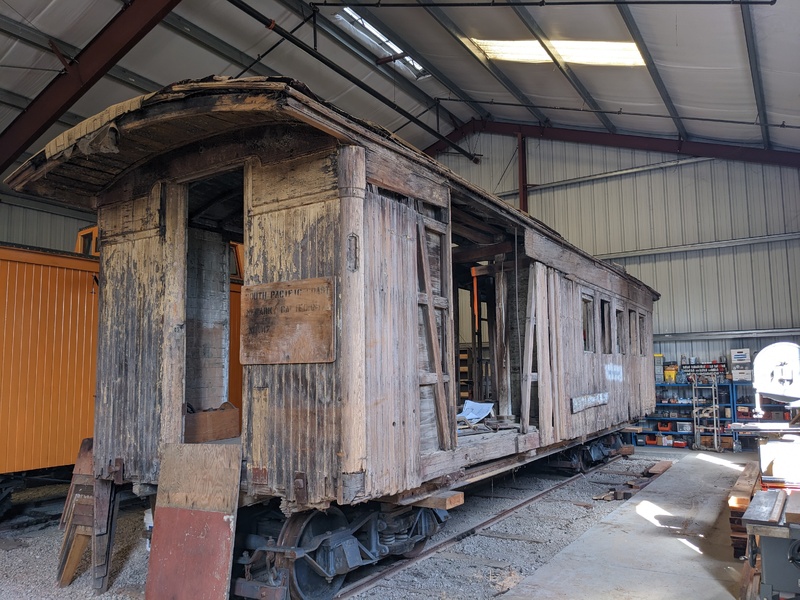
This 36-inch gauge caboose was constructed in Newark, California by Carter Brothers during the spring of 1882 as part of a four-unit order (numbers 45-48) for the South Pacific Coast Railroad. The car featured the distinctive "duckbill roof" design characteristic of Carter Brothers' caboose construction. While it resembles a passenger car, it actually served as a caboose and was equipped with link and pin couplers instead of the Miller Couplers used on passenger cars.
The SPC Railroad transitioned to the SPC Railway in May 1887 and was subsequently leased to Southern Pacific in July of that year. In 1906, following the San Francisco Earthquake and the standard gauging of the South Pacific Coast, the car was transferred to the SP-owned Nevada & California Railroad and renumbered as #455. The N&C was reorganized as the Central Pacific Railway in 1912, though the equipment remained under SP control. After decades of service, the car was retired as "worn out" on November 28, 1915.
The carbody was immediately repurposed as a railroad employee bunkhouse at Keeler, California, beginning its 53-year secondary life. The structure subsequently passed to private ownership in Keeler and was utilized as a ranch building, serving variously as a goat pen wall and storage shed.
This is the car whose rediscovery started our organization. In 1968, railroad historians discovered the long-forgotten caboose body on a ranch property. The Mission Peak Heritage Foundation purchased the carbody in 1977 and moved it to Fremont, California, where it was stored in the Patterson ranch barn, the facility that would later become Ardenwood Historic Farm Park. The car was transferred to SPCRR ownership and currently rests on substitute trucks in our carbarn. Only the carbody survives; original trucks and underframe were not preserved.
After many years of outdoor exposure, the body is severely degraded structurally, and plans to archive and restore the car continue to evolve as technology improves. The car is currently being surveyed and assessed to determine the next steps in its preservation.
Citation
"South Pacific Coast 47", Passenger Cars, The Railroad Museum at Ardenwood, accessed October 1, 2026, http://museum.spcrr.org/exhibits/show/passenger_cars/spc47.